PHRC's first birthday! Launch of PHRC 0.2 and new release of texts
Dear PHRC readers,
We are happy to celebrate the first year of the PHRC website by reaching 50 published texts and by announcing some improvements we have brought to the platform, which enters now its PHRC 0.2 phase, as well as some novelties for the new year!
1) Digital development: Introducing PHRC 0.2
The new version of PHRC is ready to welcome German translations of texts in addition to the existing English, Italian, and French translations.
Moreover, from January 2020 PHRC 0.2 will provide a stable URL to all published texts, making searchability, reference and reuse much easier and more efficient.
Finally, in 2020 a phrc_bot for Telegram will be launched, allowing for a faster search of texts via your smartphone and making it possible to spot relevant inscriptions when you are visiting an archaeological site.
Follow us for more information soon!
2) Let us now briefly explore the new items, PHRC043 to PHRC050.
Nos. 43-44 are two decrees issued by the institutions of Iasos and by a city tribe to honour King Antiochos III and Queen Laodike. Our edition of the decree PHRC043 mainly follows that by Nafissi 2001, but we have added a few new proposals, in particular one concerning the garment of the priestess of Queen Aphrodite Laodike on public events.
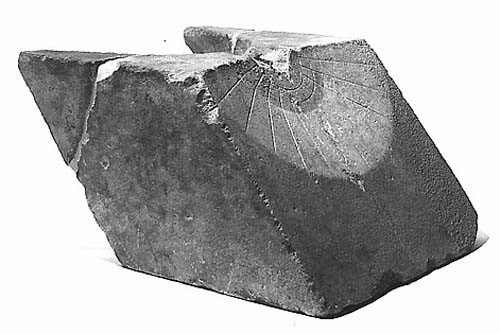
Nos. 45-46 are two small objects dedicated respectively to Ptolemy II (or perhaps III) at Herakleia near Latmos, and to Kleopatra VII at Salamis, Cyprus. Both dedications appear on uncommon objects: a conical sundial crafted by an Alexandrian technician, and a terracotta statuette of Eros riding on a rooster. The dedication no. 46 to Kleopatra VII is very problematic as regards both the content and syntax of the inscribed text, to a point that we cannot exclude that it is a modern fake.
Nos. 47-50 are four dedications for Arsinoe Philadelphos that are unique for different reasons:
- no. 47 is written on a large amphora of a funerary type well known in archaic Salamis, Cyprus, but entirely unparalleled in the Hellenistic documentation;
- no. 48 is written on a large stone block from the peninsula of Karpaz, Cyprus, which stands out as the biggest support of a dedication to Arsinoe from the whole Mediterranean;
- no. 49 is a recently plaque from Philoteria, on the See of Galilee, and counts as the only known specimen of dedication for Arsinoe from the Levant;
- finally, no. 50 comes from a Hellenistic house in Eretria and in addition to being the sole specimen from the western coast of the Aegean Sea, it provides one of the strongest pieces of evidence in favour of the household cult of the deified Ptolemaic queen.
This new release adds some new types of materials (terracotta) and objects (sundial), and various new elements to the Vocabulary list.
Nos. 46-47, from the Salamis collection of Luigi and Alessandro Palma di Cesnola, also prompt a discussion of some questionable habits of late-19th collectors, which urge modern scholars to be particularly cautious when evaluating problematic objects of unspecified provenance.
No. 49 opens up this website to regions that are not part of the geographical core of PHRC (Aegean Sea, Western Asia Minor, Cyprus). Starting from January 2020 onwards, more texts from new regions of the Mediterranean (Koile Syria, Egypt, Cyrene, Eastern Asia Minor, Mainland Greece) will be added, making the PHRC website a more encompassing portal for those interested in the ritual practicalities and social agency of Hellenistic cults for political leaders across the Mediterranean.
In the picture: a sundial dedicated to a Ptolemy (possibly Ptolemy II) in Herakleia near Latmos, PHRC045